Etiquetas

Mostrando entradas con la etiqueta 4º BILINGUAL. Mostrar todas las entradas

jueves, 5 de marzo de 2015

First Aid

You can find the App I told you about, here:

http://www.redcross.org/mobile-apps/first-aid-app


And the injuries we have to treat:
  • Sprains
  • Dislocation
  • Epilepsy
  • To faint
  • Wound- bleeding heavily
  • Burns
  • Broken bone, fracture
  • CPR (Cardiopulmonary resuscitation) manoeuvres (I will teach you this one):

jueves, 8 de enero de 2015

Homemade Juggling Balls

Welcome again and happy new year! Next week we are trying to improve our hand coordination, and a really good and funny way to do it, is juggling.
We can do our own Juggling Balls with just 2 ballons and a little bit rice, really cheap stuff.

1. With a funnel, put the rice inside the balloon. The size of your juggling balls depends on the amount of rice you use. You should hold two balls in one hand at the same time, and not to small, otherwise will be more difficult for you later.

2. Cut the neck off the balloon.


3. Cut the neck off a second balloon and stretch it over the hole to seal the rice into your juggling ball.

4. Just if you want, you can cut lots of very small holes in a third balloon by pinchingt it between your finger and thumb and carefully cutting off the tips - remove the neck and stretch over a ball to make spotty patterns.


Good luck and enjoy it!


martes, 11 de noviembre de 2014

MUSCLE CONTRACTION

If we want to improve our strength, we have to contract our muscles. As we have said in our lessons, the contraction and the stretching movement are always the opposite. Here's some examples of exercises:

CALVES


QUADRICEPS


HAMSTRING


ADUCTOR


GLUTEUS


PSOAS
This exercise is useful for our abs too.


ABS

LUMBAR


PEC


LAT


TRICEPS


BICEPS


DELTOIDS

jueves, 2 de octubre de 2014

Specific Vocabulary

I will add here all the words that we are using in our lessons and we have to learn:

1. Warming up:

  • to warm up: calentar (para un ejercicio físico).
  • start-up, joints mobility, stretching: activación, movilidad articular y estiramientos.
  • sprain: esguince.
  • strain: distensión.

2. Basic Physical Attitude: Capacidades Físicas Básicas:

  • Stamina (Aerobic and anaerobic):
    • pace: ritmo de carrera.
    • stretches: tramos (de un recorrido).  
    • slopes: cuestas.
    • Threshold: umbral.
  • Strenght:
    • Maximum strength: fuerza máxima.
    • Explosive strength: fuerza explosiva.
    • Strength endurance: fuerza resistencia.
    • Isometric contraction: contracción isométrica.
    • Isotonic contraction: contracción isotónica.
      • Concentric contraction: contracción concéntrica.
      • Eccentric contraction: contracción excéntrica.
    • Mat: colchoneta.
    • Wall bars: espaldera.
    • Medicine ball: balón medicinal.
  • Speed:
    • Movement speed: velocidad de movimiento o gestual.
    • Travel Speed: velocidad de desplazamiento.
    • Reaction Speed: velocidad de reacción (simple reaction time and discrimination reaction time).
    • Stimulus: estímulo.
  • Flexibility:


miércoles, 1 de octubre de 2014

Muscles and joints

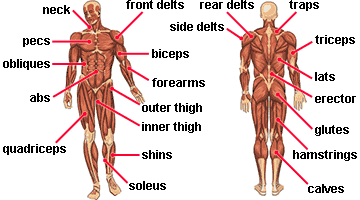
Here you have the list of the muscles we have to learn.

"Thigh" is something like "muslo", so we are not using this word. It's better if we say adductor=aductor.
Front, side and rear delts= deltoids (delts)
Neck (cuello), forearms (antebrazo) and shins (espinilla) are not muscles, so you don't need to learn it.


http://www.gymgoal.com/cday_map.jsp?frwd=lst&target=ExsLstFrame&topmargin=5


And the joints: ankle, knee, hip, shoulder, neck, elbow, wrist.


lunes, 29 de septiembre de 2014

Aerobic Threshold

Hi there ;)

If we want to improve our Aerobic Stamina, we should train it with an specific intensity. To calculate this, we can use these equations:

First of all, we need to know our Maximun Heart rate:

  • Men: 220-Age
  • Women: 224-Age
Example, if you are a 15 year old girl, your max HR would be 224-15=209 bpm

And know, we can calculate our aerobic threshold, the minimum intensity you need if you want to improve your aerobic stamina:

MinHR to improve: HR at rest+0,6 (MaxHR-HR at rest)=
  • Example for a 15 years old girld who has 60 bpm at rest: 60+0,6 (209-60)= 149,4 bpm
So, if the girl want to improve her aerobic stamina, at least she needs to train it at 149 bpm.

And know, we can calculate our anaerobic threshold, the maximun intensity you need if you want to improve your aerobic stamina. If you are training higher than this intensity, your are training your anerobic stamina, that means, with oxygen debt. To calculate it, the equation is almost the same than before:

MinHR to improve: HR at rest+0,9 (MaxHR-HR at rest)=
  • Example for a 15 years old girld who has 60 bpm at rest: 60+0,9 (209-60)= 194,1 bpm
So, if the girl wants to improve her aerobic stamina, she should train it between 149 and 194 bpm.Of course the result is just illustrative, but it could be very useful if you are training stamina for the first time in your life.


jueves, 25 de septiembre de 2014

The basic physical attributes I: Stamina.

Stamina is the basic physical attribute that allows us to do a specific type of exercise for the longest time possible without fatigue.

Types of Stamina:


  1. Aerobic Stamina: medium-low intensity for a long period of time. You have enough oxygen and you can even tlak to someone who is running with you.
    1. Aerobic power: 2-10' at 60-80% intensity.
    2. Aerobic capacity: 10'-2h at 40-60% intensity.
    3. Endurance: from 20 to several hours at 30-50% intensity
  2. Anaerobic stamina: high intensity for the longest time possible. There is oxygen debt and lactic acid is produced in your organism and reduces the intensity of the effort. If you try to tlak to someone, you won't  be able to do it properly because the oxygen debt.
    1. Alactic anaerobic stamina: very high intensity over a short time (untill 30"). Not time enough to produce lactic acid.
    2. Lactic anaerobic stamina: very high intensity between 1 and 3'. Lactic acid is produced.

Beats per minute

We will use it again next week, so, i leave it here and you can take it. If you have any question, please don't hesitate and ask me.


BEATS PER MINUTE
Write down your beats per minute during a race which lasts 10' plus 3 minutes recovery. Write down your bpm at rest(0) and after running 2, 4, 6, 8’ and 10. Then we will stop and you will be required to write down your bpm after 1' and 3' rest.

At rest
During the race
Recovery
Students
-
0’
2’
4’
6’
8’
10’
After 1’
After 3’
Student 1
70
120
140
150
170
190
180
110
80
Me


At the end, you should draw the data collected on the chart above. You have here an example, “student 1”: He starts with 120 bpm, after 2 minutes he has 140, after six minutes his heart beats 150 per minute, etc.